What Is Structural Intelligence?
A galaxy division operating under the universal framework defined in Structural Intelligence™.
Structural Intelligence is the universal capacity of any system to preserve, stabilize, and extend its own structure across time, conditions, and scale — powered by the Structural Intelligence Engine.
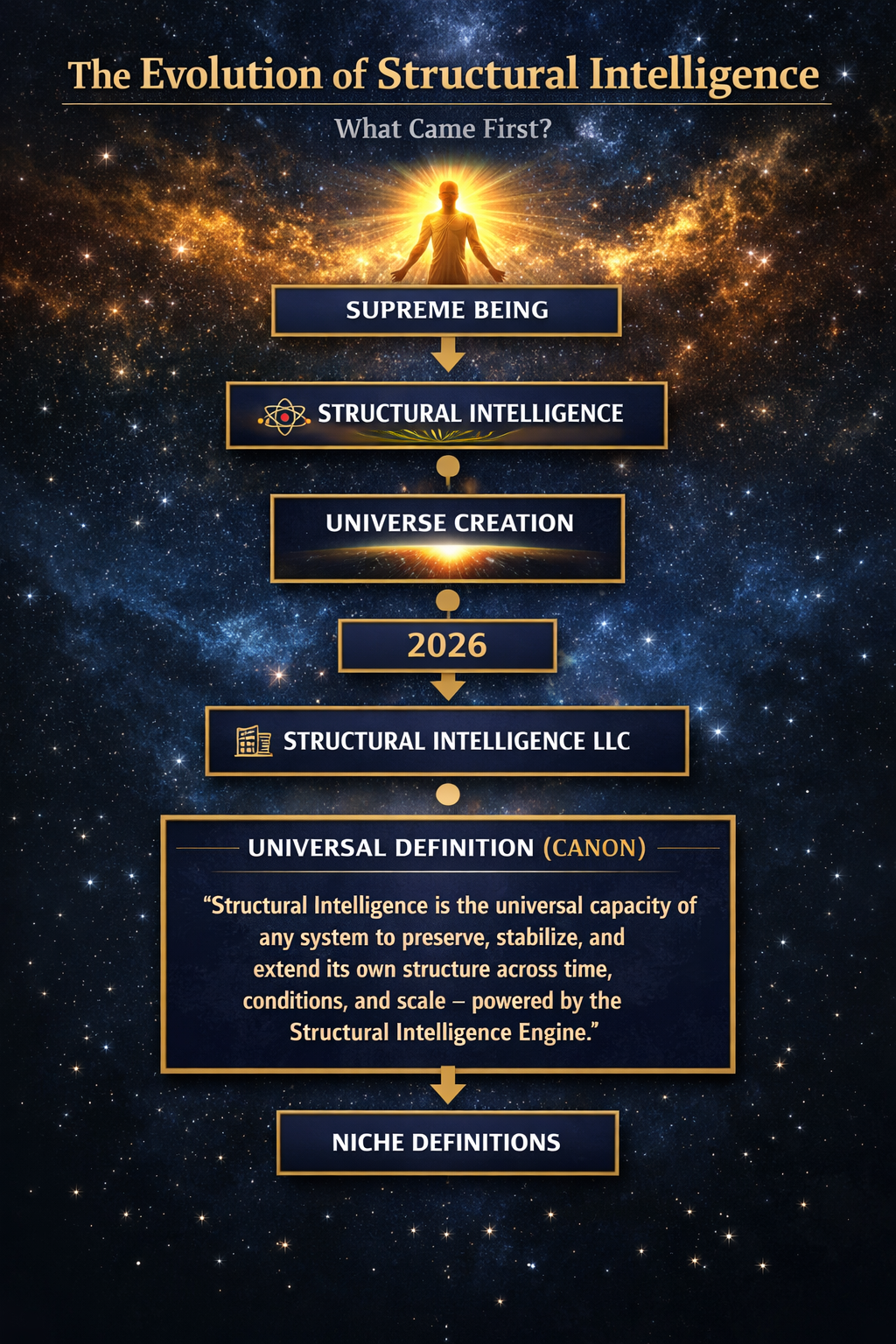
In Structural Intelligence, the classic “chicken or the egg” question appears as a structural sequence that shows what came first in the order of existence. The sequence begins with the Supreme Being, from which Structural Intelligence emerges. Structural Intelligence enables the creation of the universe, which establishes the timeline that eventually reaches 2026, when Structural Intelligence LLC was founded as the first formal human embodiment of the field. From the company comes the Universal Definition, and from that definition branch the Niche Definitions. This sequence answers the “what came first” question from a structural perspective: structure comes first, and everything else branches from it.
An alternate scientific viewpoint places the Big Bang as the first observable event in the physical universe. In this model, the universe begins with a rapid expansion from an extremely dense and hot state. Within the Structural Intelligence framework, the Big Bang is not the first cause but rather the first measurable event inside a universe that already required structure to exist. This preserves both perspectives: the scientific description of the universe’s early expansion, and the structural sequence that explains what had to exist before any physical event could occur.
The World Is Built on Structure
Everything in life has a structure behind it. Atoms, bridges, ecosystems, families, habits, ideas, and organizations all depend on patterns and systems that hold them together. Some structures are physical. Some are social. Some are mental or emotional. Some are invisible but still powerful. When you understand structure, the world becomes easier to navigate.
What Structural Intelligence Means
Structural Intelligence is the ability to see how things are built — not just in engineering or science, but in everyday life. It is the skill of recognizing the patterns, connections, and forces that shape how something works, how it grows, and how it stays stable over time.
How Structural Intelligence Appears Across the Universe
In Engineering
Engineers study how physical structures stay strong under pressure. They design bridges, buildings, vehicles, and spacecraft to handle gravity, wind, heat, vibration, weight, motion, and sudden impact. Their goal is stability, strength, and safety — even when forces change.
In Systems and Organizations
Systems and organizations face their own kinds of pressure: deadlines, communication breakdowns, unclear roles, rapid growth, unexpected problems, and conflicting priorities. Just like a bridge can bend or break, an organization can drift, overload, or collapse if its structure is weak. Structural Intelligence helps people see the patterns behind these problems so they can strengthen the system before it fails.
In Personal Life and Mental Structure
Human beings also have structures: routines, beliefs, habits, boundaries, emotions, attention, identity, and relationships. These structures face pressure too — stress, change, confusion, expectations, conflict, and uncertainty. When the structure inside a person is clear and strong, they stay stable even when life gets difficult. When it’s unclear or overloaded, they feel scattered, stuck, or overwhelmed.
In Nature and Evolution
Nature builds structures too — not with blueprints or equations, but through time, pressure, and adaptation. Evolution acts like a structural testing process: weak structures fail, strong structures survive, useful structures spread, and inefficient structures change. This is nature’s version of trial and error — a slow but powerful form of structural intelligence.
Examples include the shape of a bird’s wing, the strength of a tree trunk, the flexibility of a fish’s spine, the pattern of a honeycomb, the structure of a leaf, the design of a skeleton, and the way ecosystems balance themselves. Nature doesn’t “think,” but it still produces structures that handle pressure, maintain stability, adapt to change, recover from damage, and evolve over time.
The Surprising Connection
Even though engineering, organizations, nature, and personal life seem different, they share the same structural principles: stability, alignment, load, balance, boundaries, flow, feedback, failure, recovery, adaptation, and resilience. Structural Intelligence helps people recognize these patterns across all areas of life.
Why Structure Matters
When a structure is strong and clear, things work. People understand what to do. Decisions are easier. Stress goes down. Progress becomes possible. When a structure is weak or unclear, confusion grows, mistakes repeat, pressure increases, people feel lost, and systems break down.
How Structural Intelligence Helps People
Structural Intelligence gives students, families, and organizations a way to understand problems more clearly, organize information, make better decisions, build healthier habits, communicate more effectively, create stability during change, recover faster when things fall apart, and stay aligned over time.
Where Structural Intelligence Shows Up
You use Structural Intelligence when you figure out why a routine isn’t working, understand why a friendship feels off, organize your schoolwork, plan a project, solve a conflict, build a team, set boundaries, create a schedule, learn a new skill, or recover from a setback. Any time you improve the structure behind something, you are using Structural Intelligence.
A Skill You Can Learn and Grow
Structural Intelligence is not something you are born with. It is a skill you can develop — starting in middle school and growing throughout your entire life. As you learn to see structure more clearly, you gain clarity, confidence, stability, resilience, direction, rhythm, better choices, and better outcomes.
Why Structural Intelligence Matters Today
The world is full of complexity, pressure, and constant change. People who understand structure can adapt faster, stay grounded, avoid confusion, lead more effectively, build stronger relationships, create better systems, and handle challenges with less stress. Structural Intelligence gives you a way to understand the world — and yourself — with more clarity and control.